
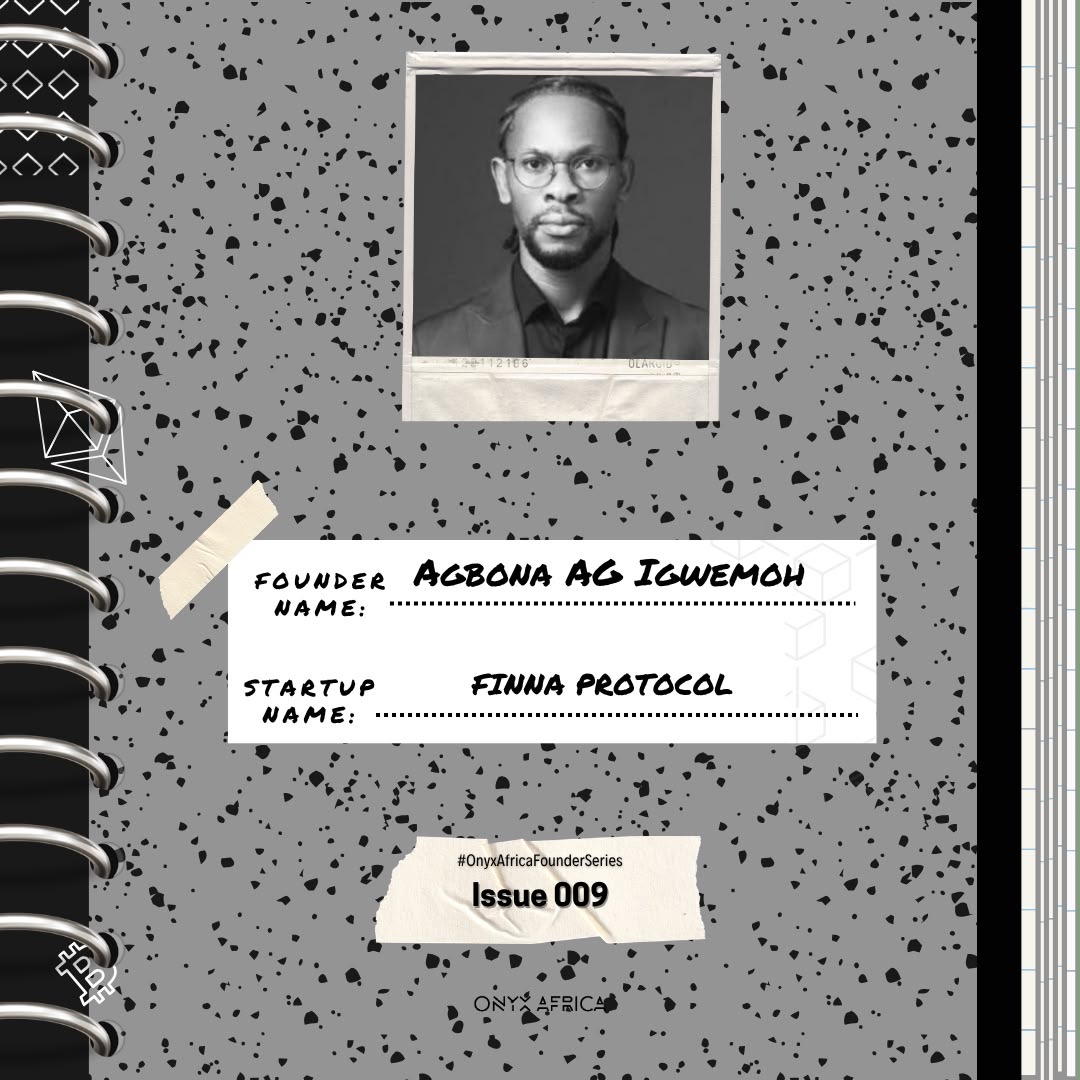
What if moving money across borders didn’t have to be this difficult?
For Agbona Igwemoh, that isn’t a theoretical question, it’s the problem he’s spent nearly a decade trying to solve.
His Web3 journey began in 2018, when he watched his brother convert Steem Backed Dollars (SBD) into Naira… What struck him wasn’t the technology, it was the fact that value had moved across borders without asking anyone’s permission.
That moment stuck!
Since then, Agbona has gone from building Finna to launching Chiss Protocol, winning Avalanche’s Codebase competition, raising institutional backing, and attempting to rethink how foreign exchange moves across some of the world’s most underserved corridors.
Agbona is not a founder who chases narratives… He is a founder who stays inside a problem until something real comes out the other side. Eight years in Web3, multiple bull runs, a crypto winter, a merger, and a conviction that has only hardened with time.
This is his story…
Agbona, let’s rewind to the beginning. Eight years in Web3 is practically an eternity – you’ve seen multiple bull runs, crypto winters, and everything in between, but before we get into Finna and the evolution of your vision, take us back to that first moment… What was your “aha” experience with blockchain? Was it a personal frustration, a business problem you couldn’t solve, or something else entirely that made you realize decentralization wasn’t just tech hype; it was a fundamentally different way to move money?
It wasn’t abstract. In 2018, at the peak of Steemit, my brother was an active creator there, earning Steem Backed Dollars (SBD) off the quality of his posts. I watched him convert SBD to Naira in real time. Dollar liquidity in Nigeria has always been gated, rationed through a handful of institutions. Watching my brother move value without asking anyone’s permission was the first time I saw what “decentralized” actually meant in practice, not as a pitch deck word, but as a transaction I could watch happen. Everything after that was just me trying to build that same moment for other people, at a bigger scale.
Today, Finna has become the home for everything you were building with Chiss Protocol… But before we unpack that journey, let’s make this crystal clear for someone who’s never touched crypto. Imagine I’m your grandmother who keeps cash under her mattress because she doesn’t trust banks. How would you explain what Finna does for her? And once she understands Finna, where does the technology that began as Chiss fit into that story?
You don’t trust banks, and you shouldn’t have to. Finna is a place where your money moves as fast as you need it to, where you can borrow against what you already have without begging a bank manager, and where sending money across a border doesn’t cost you 10% and two weeks of waiting. Finna is where this all started. Chiss came later, as our attempt to take that same idea international, an engine built to move FX across exotic corridors, not just settle Naira. Think of Finna as the house, and Chiss as the ambitious extension we tried to build onto it.
Earlier this year, you made a decision that many founders struggle to make. Rather than to continue building two separate companies, you merged Chiss Protocol into Finna. What convinced you that one focused company would create more impact than two promising ones? Was there a particular moment or series of lessons that made that decision obvious?
Two products competing for the same hours in my day and the same investor attention is a losing structure, no matter how promising both look on paper. Finna was live, generating revenue, serving real users. Chiss never made it past testnet. That’s not a hard call once you say it plainly. The lesson was blunt: users don’t care how many entities you’ve incorporated; they care whether their money moved. I’d rather run one company that wins decisively than two that both stay promising forever.
Reading your announcement, one thing stood out: users could already select Finna as their off-ramp inside the Chiss interface. It suggests the merger wasn’t really a pivot, but rather an acknowledgement of what already existed beneath the surface… Looking back, was this always one system wearing two different names?
Two systems, honestly, not one wearing two names. Finna was always the last-mile solution for the Naira corridor: stablecoin-backed lending, on/off ramp, settlement. Chiss was meant to be the international FX engine, connecting exotic corridors, with partners like Bilira handling the Turkish Lira side. They were complementary, not identical. The merger wasn’t a rebrand; it was a decision to stop splitting resources between a product that was working and a product that was still proving itself. Chiss’s role became a strategic input into Finna, not a parallel company.
You originally built Chiss on Avalanche to rethink foreign exchange settlement from the ground up; not simply digitize existing rails, but rebuild them… Now that the infrastructure sits beneath Finna, what role does Avalanche continue to play in the broader vision? Beyond the technical specifications, what made Avalanche the right strategic partner for solving real-world FX challenges across emerging markets?
Avalanche gave us the settlement layer to rebuild FX rather than skin it with a UI. We won first place at Avalanche Codebase Fall 2024, and the Blizzard Fund backed us with a $500K investment. What made them the right partner wasn’t the tech stack; it was that they treated emerging-market FX as a real problem, not a case study slide. That relationship has kept compounding. As a portfolio company, we get consistent support, investor and partner introductions, and I was invited to speak at the Avalanche Summit in London last year. We’ve been invited back for the New York summit next month.
Between Finna’s partnerships with Circle and Celo, your relationship with Avalanche through Chiss, and the broader ecosystem you’ve cultivated, you’ve earned the trust of some of the biggest names in Web3 infrastructure… What have those partnerships taught you about scaling a blockchain company? And what advice would you give to founders trying to collaborate with global ecosystems while building products that solve local problems?
Circle, Celo, Avalanche – all three taught me the same thing from different angles: global infrastructure partners aren’t looking for founders who can integrate an SDK; they’re looking for founders who understand a local problem better than anyone else in the room. My advice to founders chasing global ecosystem relationships: don’t show up asking for validation. Show up already fluent in a problem so specific that the partner realizes you’re their fastest path into that market. That’s the difference between being funded and being useful.
The story of meeting your co-founder at a wedding is the kind of human magic that gets lost in tech. “Pick someone you like,” you’ve said… Beyond liking them, what is the unspoken, essential ingredient in your partnership with Kparobo that has allowed you to navigate the immense pressure of fundraising and building ambitious financial infrastructure together?
We don’t perform confidence for each other. Fundraising and building financial infrastructure hand you a hundred genuinely uncertain moments a month. What’s kept us steady is that either of us can say “I don’t know” out loud and the partnership doesn’t wobble. Beyond liking someone, that’s the real test: can you be honest with them under pressure without it costing you anything?
One of the biggest problems you’ve consistently chosen to tackle is foreign exchange – a market dominated by legacy institutions and decades-old infrastructure… I came across a piece you were featured on that mentioned how settlements between Nigeria and Turkey can take hundreds of days, while charging fees of 5–10%. That’s insane! What made you look at a problem that large and genuinely believe blockchain could solve it? Also, why did the Nigeria-Turkey corridor become your starting point? What makes that pairing symbiotic?
Hundreds of days to settle, 5 to 10% in fees – that’s not an outlier corridor; it’s closer to the norm across routes legacy institutions stopped modernizing years ago. Nigeria and Turkey share something most Western corridors don’t: real currency volatility driving real, organic crypto adoption on both sides. We didn’t pick it as an experiment. We picked it because the demand already existed and the only missing piece was the rail.
Even though Chiss has now become part of Finna, I still have to ask about the name… Naming it after Grand Admiral Thrawn‘s species (a villain who wins through strategy, not superpowers) from Star Wars wasn’t accidental. Thrawn isn’t known for overwhelming force; he wins through patience, preparation, and strategy. What did that choice say about how you viewed Chiss’s role in reshaping global payments? Were you positioned as the strategic underdog taking on the Jedi masters of traditional finance? 👀
Thrawn wins through patience and preparation, not force. That was the point. We were never going to out-capital the incumbents in cross-border FX; that fight isn’t winnable head-on. So the posture was strategic patience: build quietly, prove it on one corridor, let results do the arguing. Underdog, yes. But an underdog with a plan, not a grudge.
You’ve described yourself as “a builder who wants to defy intermediaries and empower people to govern themselves.” That’s a compelling philosophy, but I, for one, know that reality has a way of testing ideals… What have been some of the toughest lessons in trying to live out that ethos while balancing regulation, compliance, user trust, and the practical real -world realities that influence adoption?
The hardest lesson is that regulation and self-governance aren’t actually opposites, even though it feels that way in the room. You start out wanting to remove every gatekeeper. Then you realize some gatekeepers exist because trust has to be earned somewhere in the system, and skipping that step doesn’t remove the need for trust; it just delays where you pay for it. Compliance turned out to be less the enemy of decentralization and more the price of being allowed to keep building.
You’ve teased new products like Waya and Finna for Enterprise. Without giving away any secrets, can you paint a picture of the fully realized ecosystem? When we first reached out, we were going to talk about Chiss… Now you’ve hinted at Shore, a B2B product you’re building alongside Finna. Without giving too much away, where does Shore fit into the broader ecosystem? What problem does it solve for businesses, and how does it complement Finna’s long-term vision?
Finna is the consumer front door: stablecoin-backed loans, on/off ramps, remittance, already live and moving real volume. Shore sits underneath it as the B2B layer, white-label, compliant exchange infrastructure for African crypto operators who are already routing volume informally and need real rails to grow on. Waya and Finna for Enterprise extend the same thesis into new surfaces. The throughline across all of it: never make people choose between access and compliance.
One sentence from your Finna-Chiss merger announcement really stayed with me: “One vehicle. One product to win with. One story.” In startups, founders are often encouraged to expand as quickly as possible (i.e., more products, more brands, more verticals)… Your decision went in the opposite direction – has building taught you that focus is ultimately a greater competitive advantage than breadth?
“One vehicle, one product to win with, one story” wasn’t a slogan; it was a correction. We had a product generating revenue and a product still on testnet, and for a while we were splitting attention like they were equals. They weren’t. Focus, for us, meant admitting that and doubling down on what already served users. Breadth is only an advantage once you’ve earned it. We hadn’t yet.
Nigeria consistently ranks among the world’s leading countries for cryptocurrency adoption. That’s both a blessing and a curse – high adoption but also high regulatory scrutiny. Having watched the policy landscape evolve over the years, how has that shaped the way you build? Are you designing for the regulations you hope will exist tomorrow, or the realities that exist today?
We build for today’s realities and design with tomorrow’s regulation in mind, not the reverse. Nigeria’s adoption numbers are real, and so is the scrutiny that comes with them. Founders who build only for the regulation they hope will exist get outpaced by the regulation that actually shows up.
The world often looks to Silicon Valley for innovation, but you’re proving the most profound financial solutions are being built where the problems are most acute. How is the specific context of Africa, and specific pain points, uniquely positioned to shape the future of global finance rather than simply adopt it?
Africa isn’t behind on financial infrastructure. It’s ahead on the problems that infrastructure will eventually have to solve everywhere: currency volatility, fragmented banking access, cross-border friction at a scale most Western markets haven’t had to face yet. Solutions built here won’t stay local. They’ll be the export.
If Finna succeeds at the scale you’re building toward, what changes beyond payments? What are the second and third-order effects you hope this unlocks across African economies?
Past faster payments: businesses trusting a corridor enough to build real supply relationships across it. Individuals building credit histories out of activity that used to be invisible to any financial system. Capital finally following opportunity in emerging markets instead of avoiding it because settlement was unreliable.
Looking back at the version of yourself that first started building in the space, years ago… What are some of the assumptions that turned out to be completely wrong? And which convictions have only become stronger after building, raising, listening to customers, and evolving the business?
I assumed the hardest problem was technical, building the rails. It wasn’t. Chiss proved that: we could build the engine, and it still never made it past testnet, because the hardest problem was always trust: regulatory trust, partner trust, user trust – and that takes longer to earn than any smart contract takes to write. What’s gotten stronger is my conviction that emerging-market problems need emerging-market-first solutions, not adapted versions of what worked somewhere else.
When you look at the African Web3 ecosystem today, what excites you most? And what frustrates you? Are we solving the right problems, or are too many founders still chasing speculative plays and chasing narratives instead of building products with real utility?
What excites me: the best builders here are solving for utility first; adoption is happening because something works, not because of a token incentive. What frustrates me: too much capital and attention still chases narratives instead of corridors, instead of real transaction volume. We have real problems worth billions in inefficiency. We don’t need more speculation. We need more people willing to stay inside one problem long enough to actually solve it.
For the Renaissance Kids who are curious about Web3 but intimidated by the technical complexity, what’s your advice? Where should they begin? And perhaps more importantly, how can they distinguish between chasing the latest trend and solving problems that genuinely matter?
Don’t start with the technology. Start with a problem you’ve watched hurt someone you know: a slow remittance, a bank that failed them, a currency that lost value while they weren’t looking. If technical complexity is the first thing you’re chasing, you’re chasing a trend. If a real problem is the first thing you’re chasing, the technology becomes a tool, not a personality.
Agbona, THANK YOU!
Your story is a reminder that great founders don’t just know what to build, they know what to stop building. Your journey isn’t simply about creating products; it’s about having the conviction to evolve them when the mission demands it.
Chiss wasn’t abandoned; it became the foundation beneath something bigger. That willingness to simplify, sharpen your focus, and let strategy follow conviction may be one of the most valuable lessons any founder can take from your journey.
Through Finna, you’re building more than faster payments or easier access to global financial systems. You’re challenging long-held assumptions about how money should move across borders, who gets access to financial opportunity, and what modern financial infrastructure should look like for emerging markets.
In an industry often captivated by hype, your work reminds us that lasting innovation isn’t measured by the number of protocols, products, or headlines we create. It’s measured by whether we solve meaningful problems for real people.
At Onyx Africa, we’re always searching for founders building technology that matters beyond the hype cycle. Your journey reinforces a belief we’ve held from the very beginning: the next generation of global financial infrastructure won’t simply be imported into Africa. Increasingly, it will be designed, tested, and exported from Africa to the rest of the world.
Thank you for sharing your story, your perspective, and the lessons you’ve learned along the way.
Start with the problem… Build the rails… Earn the trust… Let the results speak!
We can’t wait to see where Finna goes next.