
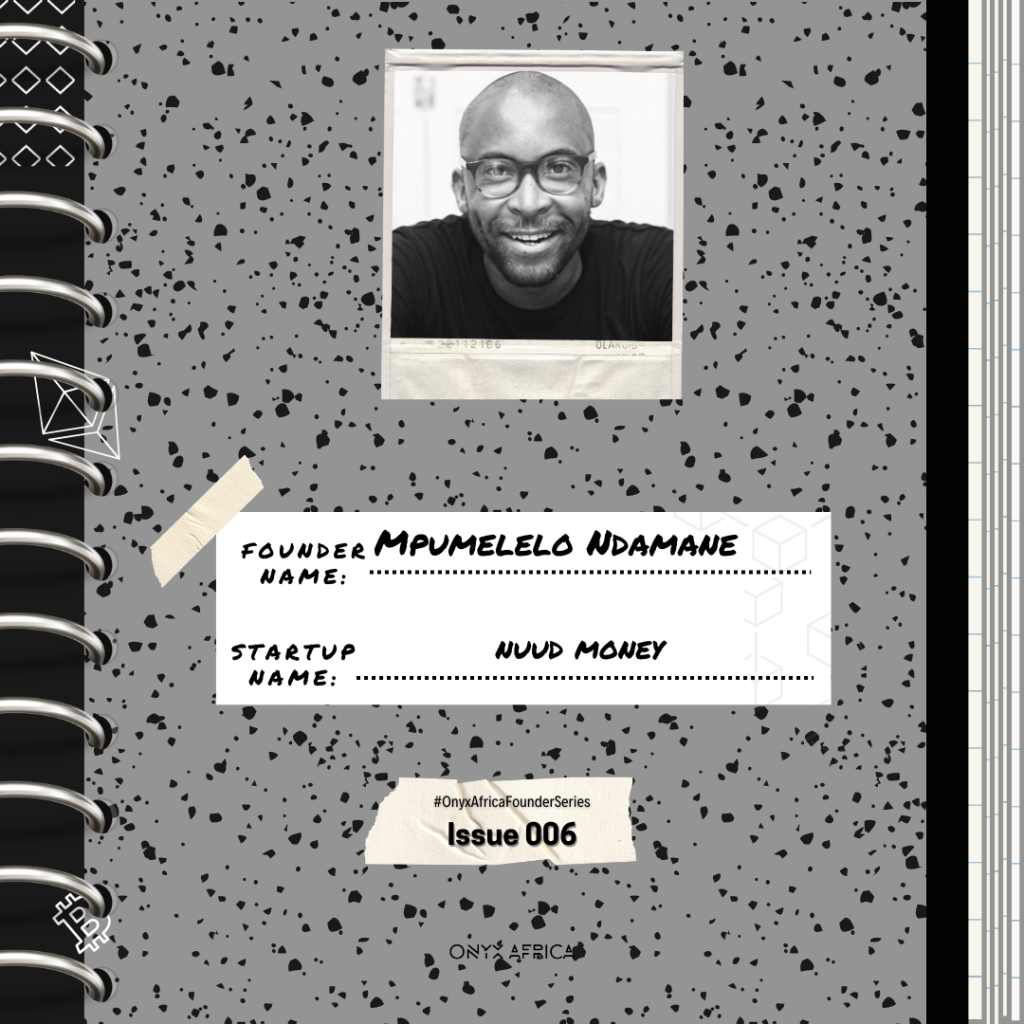
Mpumelelo Ndamane is not the archetypal tech founder. He’s a trained theologian, a jazz musician, and now the co-founder and CEO of nuud money. His path into crypto wasn’t driven by speculation or hype, but by a deep discomfort with how money systems treat people — especially on our continent.
Nuud money isn’t trying to impress. It’s trying to quiet things down.
In a world where finance feels loud, extractive, and unforgiving, Mpumelelo is building infrastructure that advances something far more fundamental than speed or yield: human liberty.
This conversation explores what happens when Web3 is approached not as a buzzword, but as a design philosophy rooted in dignity, privacy, and care.
Mpumelelo, let’s start at the beginning. You’ve gone from drummer to novice chef to startup founder. That’s an unconventional path. Rhythm and taste are intuitive; crypto is often the opposite. What was the specific moment or experience that pulled you from the creative world into the deep end of Web3 and cryptocurrency?
Although I only first touched a cellphone at 4 years old and a computer at 7—from my brother Ntuthuko who worked in technology—I still would not say I come from technology. I come from liberal arts, that’s how I’m wired. I was trained as a theologian and a jazz musician, so my world has always been about seeing and playing patterns, intuition, rhythm, and feeling. I follow patterns in some parts of my life, in some parts of people, and in the world around me, and I try to build things that make people feel safe, cared for, and understood. A really smart acquaintance Siya Gule recently suggested I read Gödel, Escher, Bach, and what a pleasure and joy that was. It revealed how thinking through music isn’t far from thinking in 0s and 1s—it’s all part of the same golden braid. Patterns in rhythm, harmony, and logic, whether in music, theology, or technology, are connected, and seeing them helps me build technology and experiences that feel intuitive, human, and deeply considered.
Starting Nuud Money wasn’t just a business idea, it was deeply personal. I worked at a bank as an Executive Assistant, and that’s when I realised how traditional finance is broken and archaic. I wanted to fix it. Early on, I applied to an incubator and got rejected. I came home and wept. Not out of shame or failure, but because I realised how much this business mattered to me, how deeply I believed in the problem we were solving, and how seriously I wanted to impact the world. That moment defined the heart of Nuud: everything we do is personal, human, and meaningful.
I’m not a “crypto bro.” I don’t chase buzzwords. I build from intuition and empathy. The technology is just a tool. What matters is that our users feel safe, cared for, and that they advance their liberty.
The name “nuud money” suggests a stripped-back, essential, no-frills approach. Your website talks about building for “people who value peace, not panic.” Beyond the branding, how does this philosophy manifest in your product design and company culture? Is combating complexity the core thesis?
Between myself and my engineering co-founder, the culture is what any other culture with two insanely passionate and ambitious people who believe in themselves would look like. It’s intense and intentional, we care. What we have shipped to date shows you who we are and how we want to run the company. We build, we talk to customers, and try to impute the feeling of liberty and care to them. “Peace, not panic” isn’t really our guiding principle. Advancing human liberty is our guiding principle. The world is noisy, chaotic, and often harsh—especially when it comes to money. Systems confuse people, punish mistakes, and make simple things stressful. At Nuud, we wanted to do the opposite, we want technology and finance to advance the liberty of everyday people.
We build great, intuitive systems that let people move, manage, and protect their money without stress. It’s not flashy. It doesn’t shout. It doesn’t rely on jargon like “Web3” or complex crypto terms, because those words only confuse—they even confuse me, you’ll never find me using web3 anywhere. Instead, we care about clarity, liberty, and human-first design.
Our goal is that every interaction leaves a user feeling safe, confident, and in control.
Can you paint a picture of who your typical user is? What does their financial journey look like before nuud money, and what does it look like after?
Our typical user is someone who wants clarity, liberty, and dignity when it comes to their money. Before Nuud, they faced frustrating systems that didn’t care about them and didn’t make things simple. After Nuud, they find a calm, secure place for their money—one that respects them, their privacy, and their choices.
Nuud users aren’t just looking for transactions—they’re looking for peace of mind. Our platform is a gentle space in a noisy world where they can feel in control, safe, and respected.
Your tagline is “send USDC to your bank in seconds” – but anyone who’s used crypto-to-fiat rails in Africa knows it’s usually more like “send USDC and pray it arrives this century.” You’re promising 6-second settlements. What’s actually happening under the hood here? Are you partnering with specific banks, building your own infrastructure, or finding clever workarounds?
Laughs “How? Honestly, I’d be a ship that leaks from the top if I told you everything we do to move money this fast!” A quick correction though, we hold “advance human liberty” as our guiding light. Moving money fast happens to be a byproduct of that. We honestly couldn’t care less about speed, what matters to the company is advancing human liberty.
But seriously—imagine a world where money is messy, slow, and stressful. A world where systems punish mistakes, make people anxious, and create noise at every turn. That’s the world most of us live in, especially on our continent. And now imagine being able to build a ship that navigates that storm with calm, care, and precision. That’s what we’re trying to do at Nuud Money.
We’re deeply grateful to live in a time where technology allows us to build things that matter. Tools that let us rethink how money moves—not just faster, but safer, simpler, and more humane. We’re using blockchain technology to do this. It’s not about hype, it’s about designing systems that work quietly and reliably, so people don’t have to stress, guess, or panic. So, to the question “how?” the answer is Blockchain.
Every choice we make is about care. About creating a space where moving money feels human, not chaotic. Where privacy is respected. Where people can feel confident, safe, and in control. In a noisy, harsh world, we want Nuud Money to be calm, clear, and steady. We’re working towards this.
You’ve written eloquently that “secret words are safe words” and that “not even nuud money’s best engineer can touch them.” In a continent where many may be wary of self-custody (i.e., losing keys = losing funds), why was this non-negotiable for you? How do you educate users and build trust around such a profound responsibility?
People are already holding a bulk of their most prized possessions safely. We think they can gladly and easily hold their secret words safely. I think assuming they won’t is an insult to them. Secret Words matter because Privacy is core to everything we do. We’ve all had moments where our privacy was compromised, and we want to make sure that doesn’t happen with your money. Digital wallets allow people to keep outsiders out, and we start simply with “secret words”—an intuitive, human way to manage security.
Self-custody isn’t about showing off or complexity. It’s about empowerment and trust. People have full control over their money, and we give them the tools and guidance to feel confident managing it. We are far from perfect, but we’re committed to simplicity, clarity, and care. Our goal is to make security feel natural, not intimidating.
We educate them by writing pieces like “Secret words are safe words”. We educate them by always having our lines open towards them. We educate them by actually building with care and empathy.
I have to bring up this recent LinkedIn post of yours: “actually, regulating decentralized assets with centralized frameworks is like forcing the internet into fax machine rules.” That’s a spicy take. You’re operating across multiple African jurisdictions while being Delaware-incorporated. How do you navigate this tension between borderless ideals and very real regulatory boundaries?
Laughs! I’ve had this thought for a while, I mentioned it to coindesk a while back. It’s just that simple for me, I do not think you can regulate what’s new with frameworks that were created for a different type of technology and people. To regulate digital currencies, you’d have to have a totally different entity that comprises actors from different parts of the industry, not just state actors. You’d have to have this new agency be structured like a Decentralised Autonomous Organisation. Inspired also by The Network State by Balaji.
A side note and a reference to how we navigate borderless ideals is actually something I would like to see being worked on soon; a stablecoin that works and empowers African and emerging market economies. I say the economies and not necessarily the governments. I think the governments are okay, I don’t think they need our help. We’re helping them enough as is. The coin or currency [depending on where you live] should not be inflationary. The coin or currency should be decentralised and not issued by a centralised entity.
On the beauty of regulation, I deeply believe regulation matters—for many reasons, a lot of them mainly being philosophical and psychological. It matters not purely for politics or States—it matters for people. Good regulation protects everyone. Safety should be universal. When regulation is done well, it allows innovation to flourish safely, protecting both users and the systems they rely on.
You wrote about building “a future where humanity doesn’t just own assets, but owns data and decides who gets access to it.” That’s moving beyond payments into something bigger. What’s the long-term vision here? Are we talking about a full-stack identity and data sovereignty platform? Also, your writing has this consistent thread about “advancing human liberty” and building products that aren’t built to impress, but to free. That’s powerful language, but it also sounds like you see nuud money as more than just a FinTech product – almost like a political statement. Is that intentional?
Laughs softly — You see, that’s the thing. The moment you start talking about liberty, people think you’re running for office. But no, it’s not political. It’s human.
When I say “advancing human liberty,” I’m not talking about rallies or manifestos — I’m talking about dignity. About creating tools that don’t trap people in systems they can’t understand or control. The truth is, the world is harsh on people — especially financially. It’s noisy, extractive, and filled with gatekeepers. Most of us just want a simple way to live, save, send, and protect what’s important to us— without fear, without fine print, without panic.
So when I talk about “owning data” or “deciding who gets access,” I’m really talking about building for a future where people have real choice. Money is just the beginning. Payments are the most visible part of our lives that touch every other system — identity, data, communication, trust. If we can design a financial layer that respects people’s privacy and autonomy, we’re already halfway to building a world that feels safer and freer.
Are we talking about a full-stack identity and data sovereignty platform? Maybe one day, we will see. But not in the cold, big corporate sense. We’re not chasing that. We’re exploring what it means for a person to have full ownership of their digital self — to decide what they share, who they share it with, and why. That doesn’t have to be complex. It starts with care, with clarity, with simple, human systems that don’t manipulate or confuse.
Nuud Money is for the sake of advancing human liberty. That’s the golden thread that runs through everything we do. Whether it’s sending money home, protecting your privacy, or giving you control over your data, we have to advance your liberty.
In a time where most tech amplifies noise, we’re trying to build silence — space for people to breathe, own their time, and live with confidence. If that feels political, maybe that says more about the world we’re building against than it does about us.
Beyond nuud money, how do you see Africa’s Web3 and crypto ecosystem evolving over the next 5–10 years? Are there specific use cases you think will define adoption here versus elsewhere in the world?
Smiles. I am actually looking forward to the next 5 years. I think over the next 5–10 years, the most important thing on the continent will still be moving money — safely, with trust, and with care.
That’s where it all begins. Before we talk about complex systems or new technologies, we have to solve for movement — how people send, receive, and protect value in their everyday lives. In Africa, that’s not an abstract problem; it’s daily life. Remittances, trade, family support — those are the real use cases.
I think adoption here will be shaped less by hype and more by need. People don’t care about “Web3” or “crypto” as labels — they care about reliability, speed, and safety. When technology can help someone move their money home faster, or receive payment for their work securely, it becomes meaningful.
So yes, the next decade will be about trust — not just in the systems we build, but in the people behind them. Whoever earns that trust and keeps it will define adoption. Everything else — identity, data, digital assets — will grow from that foundation of safe, honest movement.
For the budding entrepreneurs reading this who are passionate about using technology to solve real problems in Africa, what would your advice be? Especially those who might not fit the typical tech founder mold – the drummers, the chefs, the unconventional thinkers?
Ah, those are my people. The Advocates who wear pink on wednesdays, the investment bankers who love the dramatic arts, the drummers in technology, the flower-field frolickers, the painters, the poets, the PhDs in biochemistry who took the road less travelled, those who couldn’t graduate in “record time” but did it anyway, ultimately those who really want to move humanity forward — the ones who see the world a tad differently. I think the first thing I’d say is: don’t try to fit the mould. The mould was never made for you anyway.
The world doesn’t need more of the same. We need people who can build things with care, with colour, with rhythm, with intuition. If you come from an unconventional background, that’s not a weakness — that’s your advantage, a good friend of mine Kwanele said this to me in 2017. You already understand pattern, timing, flow, and emotion — the things most technologists forget.
Those who don’t fit the mould should make their own moulds. Dissenting voices, new perspectives—they make the world better.
My advice? Build. Build for humans.
In closing, what’s one takeaway you’d want readers to leave with about nuud money and your broader mission?
Laughs —Get the app on Android. It’s the most beautiful thing in the world right now you should use it and tell us what you think on @nuudmoney or me on @mpumelxlx
But really, beyond that — I want people to leave with this thought: the world is noisy, money is noisy, and life can feel harsh. We built Nuud Money to be the opposite of that — a quiet place for your money. A place built with care, with clarity, and with your liberty at heart.
So yes — download the app. Experience what we’re building. Feel what care in technology can be. Because the future we’re building isn’t just about moving money — it’s about helping humanity move with more calm, more dignity, and more freedom.
Thank you, Mpumelelo. Seriously, this was fantastic. You have a rare way of cutting through the complexity to what actually matters: building things that make people feel safe, respected, and in control. It’s been a real privilege to hear your thoughts.
What’s striking about this conversation isn’t the technology (though six-second settlements are impressive). It’s the philosophy underneath it. The insistence that self-custody isn’t intimidating; it’s actually empowering. The belief that regulation should protect people, not just states. The conviction that “advancing human liberty” isn’t political theatre; it’s product design.
In a continent where money movement is daily survival (remittances, trade, family support), nuud money’s promise is simple: make it fast, make it safe, make it human. No noise. No panic. Just a quiet place for your money.
Mpumelelo’s path from drummer to theologian to founder proves something the tech world often forgets: the best builders don’t always come from engineering. They come from empathy. From pattern recognition. From seeing the world differently and refusing to accept that complexity is inevitable.
Africa’s Web3 story won’t be written by those chasing hype. It’ll be written by builders like Mpumelelo who understand that trust matters more than speed, that care matters more than features, and that technology is only meaningful when it advances the liberty of everyday people.
nuud money is proving that sometimes the most revolutionary thing you can build is silence.
Advance your liberty.