
On February 3rd, 2025, Andrej Karpathy (former Director of AI at Tesla and part of OpenAI‘s founding team) dropped a tweet that went viral and accidentally defined a revolution.
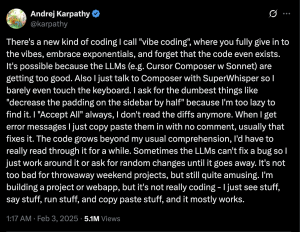
His definition was as provocative as it was precise: an AI-assisted programming paradigm where the developer can essentially “forget that the code even exists.” This was not merely an incremental improvement to the developer workflow. It was a fundamental reimagining of the act of software creation itself, challenging our deepest assumptions about technical skill and value.
For decades, the industry has cursed “legacy code,” the cryptic and unmaintainable systems that grind progress to a halt. We understood, on some level, that programming was never truly about producing lines of code, but about theory building; the construction of a deep, coherent mental model of how a system operates and interacts. Vibe Coding, in its purest form, strategically inverts this. It outsources the code production so completely that the human’s primary role shifts from builder to curator; a curator of the idea, the outcome, and the user experience.
So, what is Vibe Coding in practice? It is a development approach that leverages Large Language Models (LLMs) to generate code, shifting the programmer’s role to guiding, testing, and refining the AI’s output.
In essence, Vibe Coding is a new way of developing software through collaboration with LLMs. The human shifts from “coder” to “director.” The AI handles generation; the human handles guidance, testing, and alignment. It’s a workflow that feels fluid and natural, and it’s already redefining what productivity looks like in software.
The benefits are clear. AI-driven productivity means developers can complete projects in a fraction of the time. The barrier to entry drops dramatically, empowering non-technical creators to participate in building tools and products. Enhanced code quality emerges from AI tools that catch bugs early and enforce best practices. Most profoundly, it democratizes creation. The “how” of programming becomes less critical than the “what,” enabling a new class of creators to bring their ideas to life.
This is the philosophy behind tools like VibeCode, founded by content creator Riley Brown. In a YouTube video, Sean Chen builds an entire mobile app from scratch without writing a single line of code:
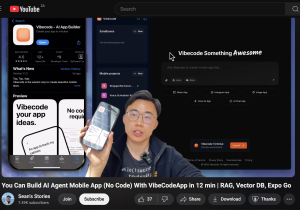
He prompts, observes, verifies, and iterates — all in real time. It’s a perfect representation of how software development is shifting. As Balaji Srinivasan once noted:
The new bottlenecks are prompting and verifying.” In other words, value is moving away from syntax and toward sense-making. The most valuable skill now lies in knowing how to talk to the machine and how to judge what it returns.
Still, not everyone sees it this way…
A common misconception is that Vibe Coding is a binary state. It is not. It operates on a spectrum defined by one crucial variable: the depth of the creator’s understanding of the underlying code.
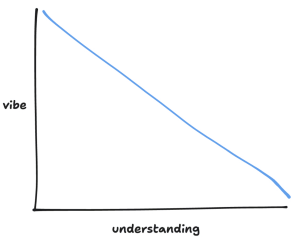
Graph by Steve Krouse
On one end, the expert developer uses AI as a powerful co-pilot, accelerating complex tasks within a fully comprehended and controlled codebase. On the other end, the “non-technical” idea person acts as a conductor, specifying the symphony’s vision and trusting the orchestra of AI to play the notes. The more you understand, the less you are vibing; the less you understand, the more you are. This spectrum is the source of both its revolutionary potential and the fierce debate it ignites.
This spectrum inevitably creates a schism. Traditionalists, who have invested years in mastering the arcane syntax of programming languages, view Vibe Coding with deep skepticism. To them, it represents the ultimate accumulation of technical debt, incurring obligations at the speed of an LLM. They foresee a future cluttered with fragile, incomprehensible systems built by those who lack the foundational knowledge to maintain them.
The value is no longer anchored in the ability to write a “for-loop” in Python. It has shifted to the ability to articulate a complex, unambiguous requirement and, just as crucially, to possess the critical thinking to verify that the AI’s output is correct, efficient, and secure. The most valuable individual in the room is becoming the one who can best prompt and verify.
This evolution leads us to an inevitable and profound conclusion: it is time for the Idea Guy to win.
Karpathy foreshadowed this moment even before coining “Vibe Coding” with his declaration:

This was not a flippant remark but a strategic forecast. The limiting reagent in innovation is no longer the technical capability to implement, but the clarity, creativity, and vividness of the idea itself.
The individual who can most accurately and compellingly articulate a vision in natural language now holds the keys to direct creation. They are no longer just the “idea person” lobbying for engineering resources; they are the Idea Architect, directly orchestrating AI to translate their vision into a functional reality. They operate at the highest level of abstraction, focused purely on the “what” and the “why,” while the AI handles the “how.”
Vibe Coding is more than a productivity hack; it is the latest and most significant abstraction in the history of computing. It is a foundational shift from a world where we must learn to speak the language of computers to one where they are finally learning to understand us. The implications extend far beyond software, poised to reshape every industry it touches. The vibes, it turns out, are becoming the most powerful architecture of all.